Estri battles to regain her identity after being denied her
memories by her captor.
Will love find a way?
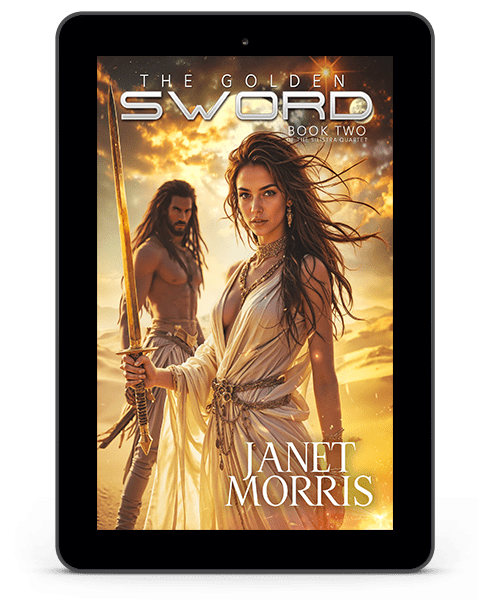
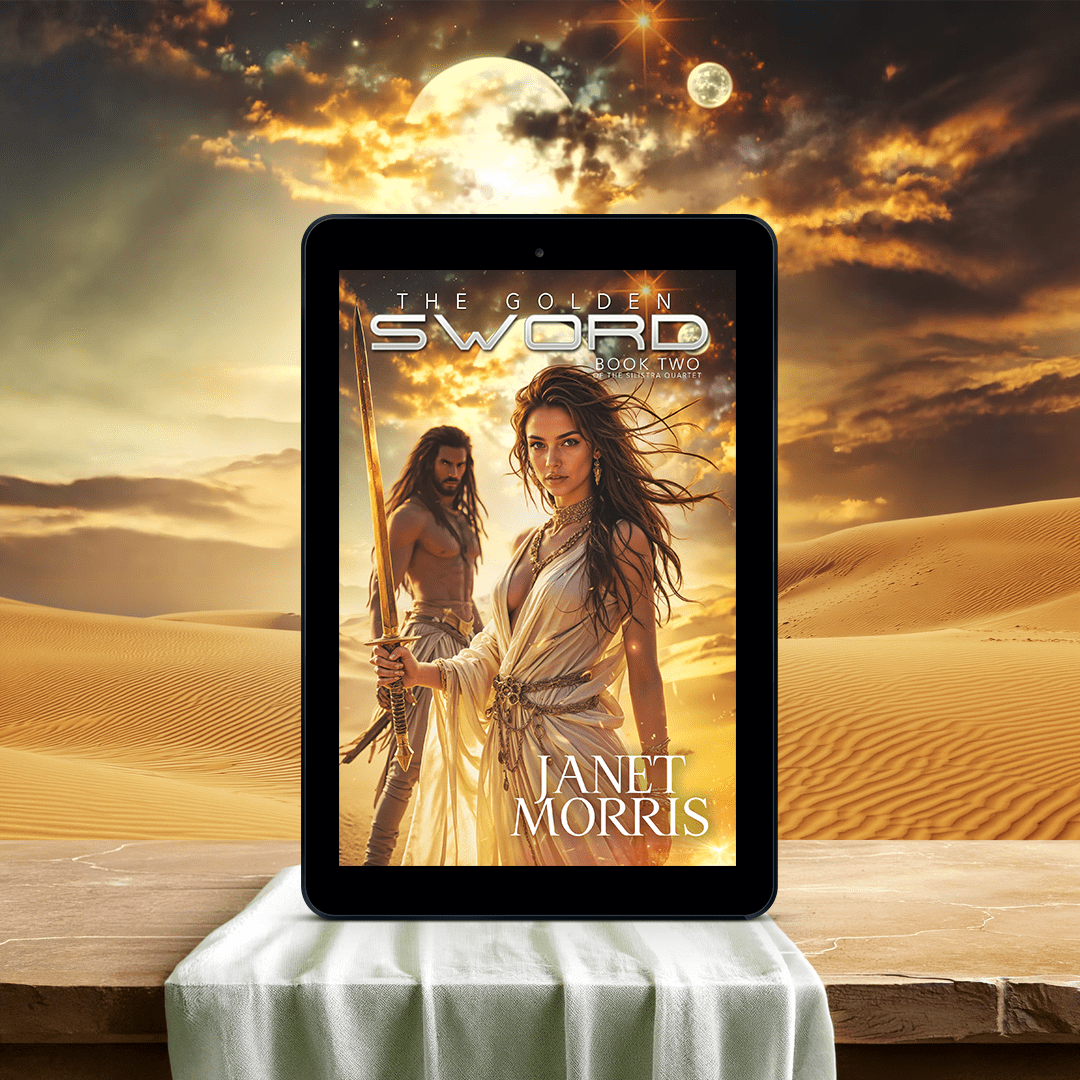
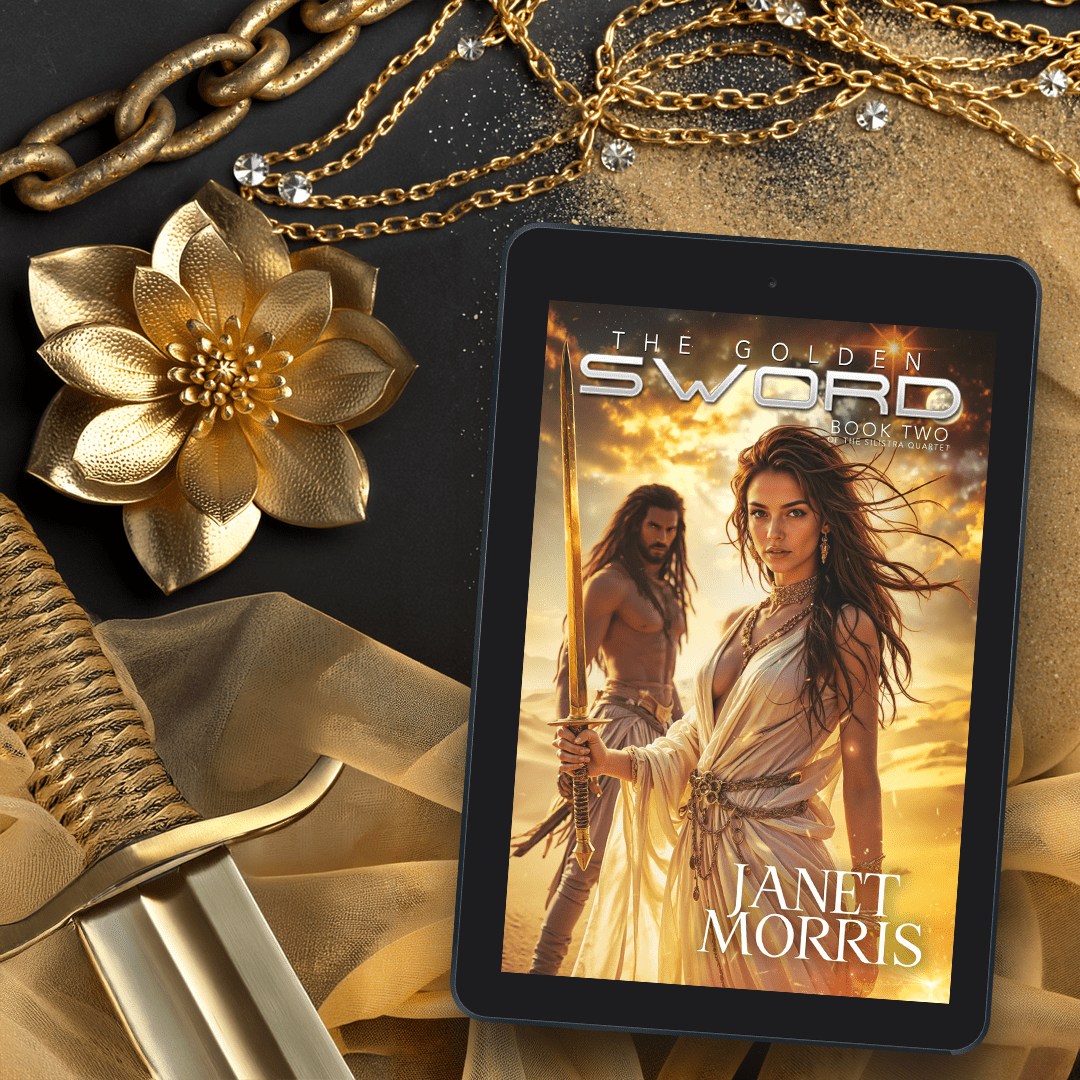
The Golden Sword
The Silistra Quartet Book 2
by Janet Morris
Genre: Dystopian Epic SciFi Fantasy Romance

Dystopia. Biology shapes reality. The further adventures of
the most beautiful courtesan in the galaxies of tomorrow.
She had the power to create planets. The sixty carved bones
of the Yris-tera foretold her ancient fate. Her heritage of power took her
beyond time and space and stole from her the one man she loved.
Enslaved on the planet Silistra tomorrow's most beautiful
courtesan unleashes the powers of the gods.
What readers
are saying:
“Pure
excellence…. A heroic quest of the highest calibre.” - Goodreads
“This is a book which makes one’s blood sing and one’s
mind ponder. I loved the first in the series and enjoyed this as much, perhaps
more. The ending leaves the reader desperate to know what happens to Estri next
– courtesan, slave, warrior, lover, rebel. What is next for our heroine?” –
Goodreads
“Call it what you like: science fiction, space opera,
sword and planet or erotic fantasy . . . The Golden Sword is all these things,
and so much more. A highly intelligent and sensual novel filled with ideas and
revelations, this is a gripping story that explores human sexuality and the
role it plays in politics. Although the memorable characters are bisexual, toss
away all your preconceived notions, for there is a humanity, a strength of will
and determination, a realism and depth of emotion to these characters that will
have you thinking twice about all you know and all you think you know. This is
a book for mature and discerning readers who like some meat on the bones of the
books they read. Janet Morris led the way for all the science fiction authors,
both male and female, who came after. “ – Joe Bonadonna, Goodreads
Amazon * B&N
* Bookbub
* Goodreads

I wondered what it meant, to be a “ten,” as the crellkeep
chose a spot apparently like any other upon one chain and fastened me to it by means of heavy metal anklets
that were spaced along its
length.
“I put you next to Aje. You will sleep
through the nights,” he informed me, as if I should be grateful for some
thoughtful service. Seeing me safely bound, the two jiasks turned and left the
chamber.
“What
is your name?” the crellkeep asked.
I almost told him, but caught myself.
It took me a moment to remember the crell name Chayin had given me.
“Miheja,” I said finally.
“Meh-he-ya,” the crellkeep corrected
me gently. “The Eastmost Star’s Daughter. Suits you. So you have the dharener
entranced, do you? A ten, indeed. Crell life is no burden to one so highly
numbered.” He stood up, rubbing his back, “I go to get Aje. You will like him.
They all do,” he said and patted my naked shoulder. Moments later I was alone in the deserted
ever-dusk of the crellpits. A single torch burned at the chamber’s
entry, throwing life into the feature-
less rock walls.
I crawled
the length of my tether,
and by lying stretched out
could just get my fingers upon the central ring. I tested its strength,
as had countless crells before me. There was no weakness in it. I had expected none. I
then examined each link of my chains with my fingers, to see if perhaps
somewhere there was one unsoldered among them. There
was no error among the 387
links that bound me firmly to the central ring. Its twin was sunk where
the cold stone
floor met the wall behind me. Perhaps there was a
weakness in that area, but I had not enough tether to explore it. I lay down upon my
left side and curled my knees against my chest. I could not think. I merely lay
there.
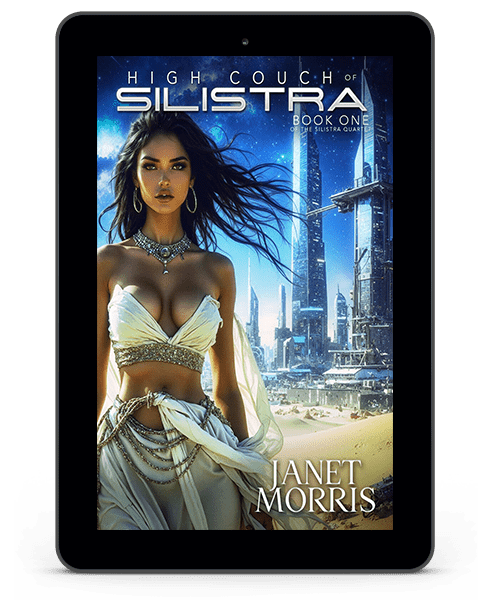
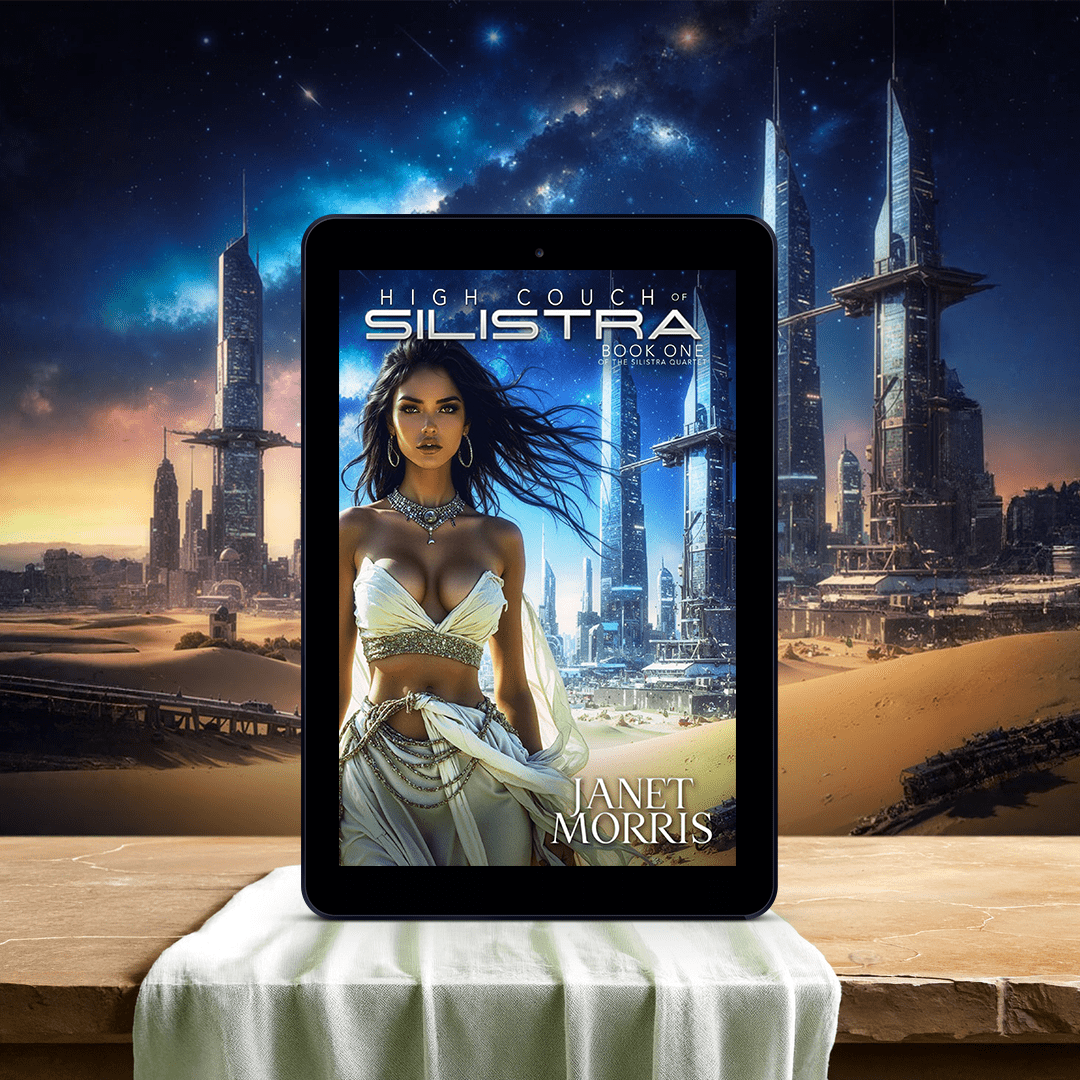
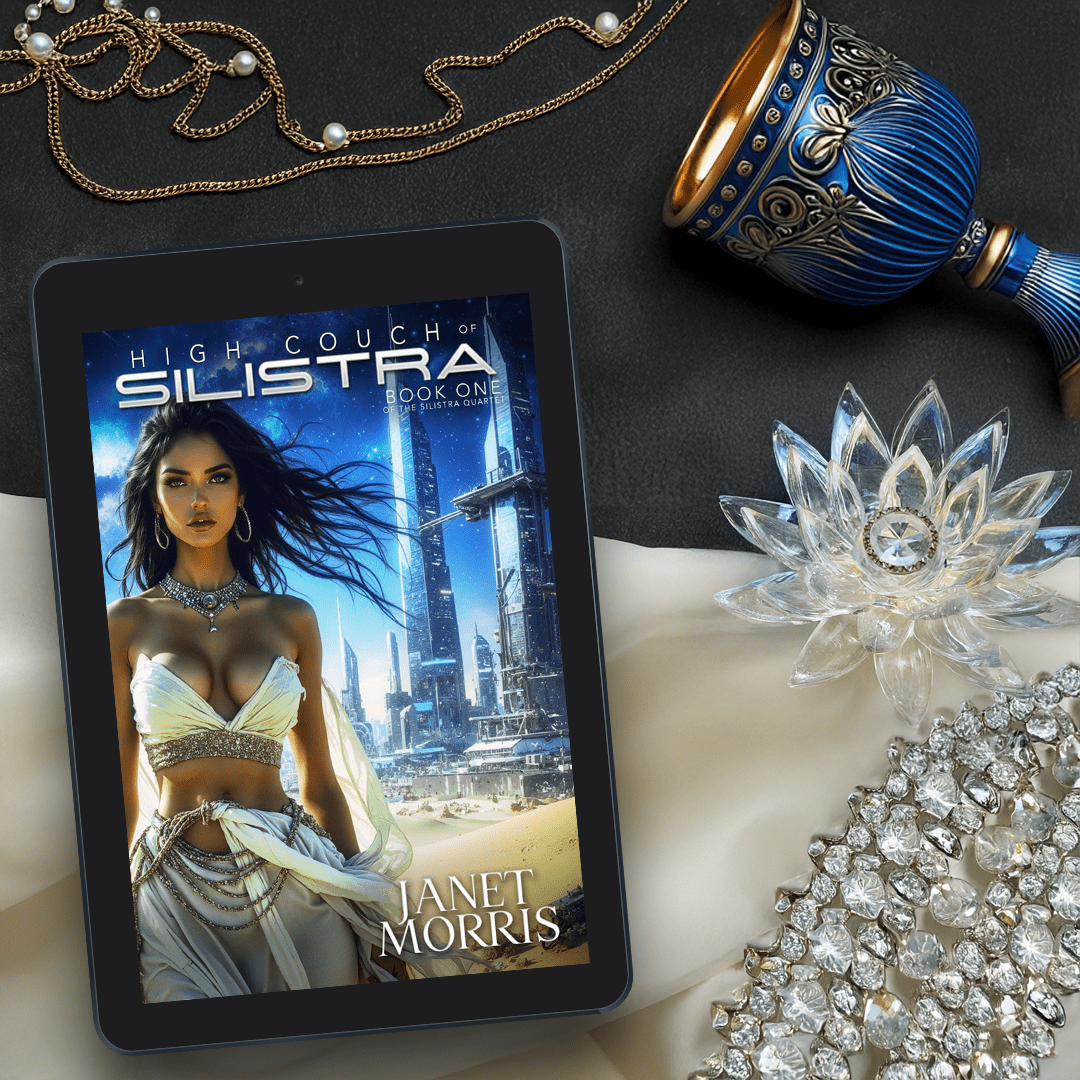
High Couch of
Silistra
The Silistra Quartet Book 1
Biology shapes reality...
One woman's mythic search for self-realization in a distant tomorrow...
Her sensuality was at the core of her world, her quest beyond the civilized
stars.
Aristocrat. Outcast. Picara. Slave. Ruler.
"Engrossing characters in a marvelous adventure." - Charles N. Brown,
Locus Magazine
"The amazing and erotic adventures of the most beautiful courtesan in
tomorrow's universe" - Frederik Pohl
"The best single example of prostitution used in fantasy is Janet Morris'
Silistra series... Estri's character is most like that of Ishtar who describes
herself as "'a prostitute compassionate am I'" because she
"symbolizes the creative submission to the demands of instinct, to the
chaos of nature ...the free woman, as opposed to the domesticated woman".
Linking Estri with these lunar and water symbols is not difficult because of
the moon's eternal virginity (the strength of integrity) links with her changeability
(the prostitute's switching of lovers). [...]
Morris strengthens the moon imagery by having Estri as a
well-keepress because wells, fountains, and the moon as the orb which controls
water have long been associated with fertility, [...] In a sense, she is like
the moon because she is apparently eternal, never waxing or waning except in
her pursuit of the quest; she is the prototypical wanderer like the moon and
Ishtar. She is the eternal night symbol of the moon in opposition to the
Day-Keepers [...]
At her majority (her
three hundredth birthday), she is given a silver-cubed hologram letter from her
mother, containing a videotape of her conception by the savage bronzed
barbarian god from another world. [...] If Estri's mother then acts as a bawd,
willing her lineage as Well-Keepress to her daughter, then Estri's
great-grandmother Astria as foundress of the Well becomes a further mother-bawd
figure when she offers her prophetic advice in her letter: "Guard Astria
for you may lose it, and more. Beware of one who is not as he seems. Stray not
in the port city of Baniev ...look well about you, for your father's daughter's
brother seeks you". Having no brother that she knows of does not stay
Estri from undertaking the heroic quest of finding her father."
- Anne K. Kaler, The
Picara: From Hera to Fantasy Heroine
Amazon * B&N * Bookbub * Goodreads
I
am Estri Hadrath diet Estrazi, former Well-Keepress of Astria on the planet
Silistra. I have begun three times to tell this story, and three times I have
been interrupted. This, then, the fourth attempt, will surely prove successful.
Perhaps
you have heard of Silistra, the planet that was catalyst to the sexual
revolution in the year twenty-two thousand, seven hundred and four Bipedal
Federate Standard Time, or of the Silistran serums that lengthen life and
restore vitality in virtually any bipedal life form, or perhaps you have at
some time contracted the services of a Silistran telepath, or a precognitive,
or a deep reader. It is possible that you have in your own home the
scintillating, indestructible web-cloth woven by our domestic arachnids, or
have seen holograms of our golachits, those intelligent builder-beetles who
exude from their mouths a translucent, superhard substance called gol and
create from this gol, under the guidance of the chit-guards, the formidable and
resplendent structures in which we live and work.
And
perhaps you have seen no web-cloth, no gol, never been ill, and are not
interested in sex. If so, you may never have heard of Silistra.
I
carry Silistra in my mind’s eye, here under this alien sun. In my mind alone
can I look out the east window of my beloved exercise hall in Well Astria and
see the sun’s rising burst upon the jewel-like towers and keeps of the Inner
Well and a thousand rainbows arc and dance in the greening sky.

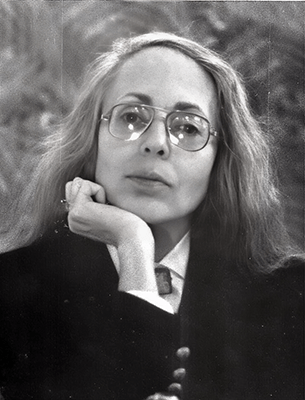
Best selling author Janet Morris began writing in 1976 and
published more than 30 novels, many co-authored with her husband Chris Morris
or others. She contributed short fiction to the shared universe fantasy series
Thieves World, in which she created the Sacred Band of Stepsons, a mythical
unit of ancient fighters modeled on the Sacred Band of Thebes. She created,
orchestrated, and edited the Bangsian fantasy series Heroes in Hell, writing
stories for the series as well as co-writing the related novel, The Little
Helliad, with Chris Morris. She wrote the bestselling Silistra Quartet in the
1970s, including High Couch of Silistra, The Golden Sword, Wind from the Abyss,
and The Carnelian Throne. This quartet had more than four million copies in
Bantam print alone, and was translated into German, French, Italian, Russian
and other languages. In the 1980s, Baen Books released a second edition of this
landmark series. The third edition is the Author's Cut edition, newly revised
by the author for Perseid Press. Most of her fiction work has been in the
fantasy and science fiction genres, although she has also written historical
and other novels. Morris has written, contributed to, or edited several
book-length works of non-fiction, as well as papers and articles on nonlethal
weapons, developmental military technology and other defense and national
security topics.
Janet said: 'People often ask what book to read first. I
recommend "I, the Sun" if you like ancient history; "The Sacred
Band," a novel, if you like heroic fantasy; "Lawyers in Hell" if
you like historical fantasy set in hell; "Outpassage" if you like
hard science fiction; "High Couch of Silistra" if you like far-future
dystopian or philosophical novels. I am most enthusiastic about the definitive
Perseid Press Author's Cut editions, which I revised and expanded.'
Website * Facebook * Twitter * Instagram * Bookbub * Amazon * Goodreads
GUEST POST
What is something unique/quirky about you?
I breed Morgan horses. I consult with Morgan breeders to help them choose breeding combinations to achieve a desired result.
I am also a song writer; I play bass guitar with my husband Chris who sings and plays guitar. We have an album on MCA records. Look for Christopher Crosby Morris on Soundcloud or N1M.com
Can you, for those who don't know you already, tell something about yourself and how you became an author?
I wrote my first novel, High Couch of Silistra in 1975; a friend sent it to an agent who chose to represent me; I had already written the second book in the Silistra Quartet and my agent told me not to disclose that until they finalized the contract for the first one. When the publisher learned of the others, Bantam Books bought the succeeding three. When the fourth book was published, the series already had four million copies in print. Suddenly I was a novelist specializing in environmental, gender, historical and political subjects. In the process, Chris became my editor and ultimately a co-writer. Since then, we have co-authored many books.
Who is your hero and why?
Heraclitus of Ephesus, a pre-socratic philosopher, whose Cosmic Fragments foreshadow our knowledge of reality and how to perceive it. Among his precepts is the statement that change alone is unchanging. I’ve worked Heraclitus’ fragments in here and there throughout our books.
Which of your novels can you imagine being made into a movie?
All of them. I write cinematically, our books are vivid adventures I undertake without knowing the destination. I, the Sun, The Sacred Band, and Outpassage are particularly suited to film. The Threshold Series is a feast of opportunities for today’s special effects creators.
What inspired you, to write The Golden Sword?
The Silistra series was a unique departure for me and it included issues of women’s rights in the 70’s before Handmaid’s Tale.
Convince us why you feel The Golden Sword is a must read.
The Silistra series in which The Golden Sword is book 2 blazed a new trail in science fiction and fantasy, many critics saying that Janet Morris had created a new pantheon of warrior women giving rise to heroines like Xena. Today it is more important than ever for everyone to accept to women in leadership roles and I would like to think we had something to do with gaining them more recognition.
Who designed your book covers?
Most of my covers, including The Golden Sword, are realized by Roy Mauritsen, a gifted graphic artist.
Advice to writers?
As for advice to writers, here is all I know: write the story you want to read. Start at the beginning, go to the end, and stop. Seriously. From start to finish you must inhabit the construct in a manner that makes the reader choose to continue; if I, as the writer, can’t feel what it’s like being there, my readers can’t either. So close your eyes, look at your feet where they are standing on the story’s ground; tell me what you see. Tell me what you hear. Ask at the end of each paragraph ‘what happens next?’. If you lose touch with it, wait until you’re back inside it. Tell the story that comes to you, and from you, to me.

Follow the tour HERE for special content and a giveaway!
Enter The Golden Sword Giveaway Here


No comments:
Post a Comment