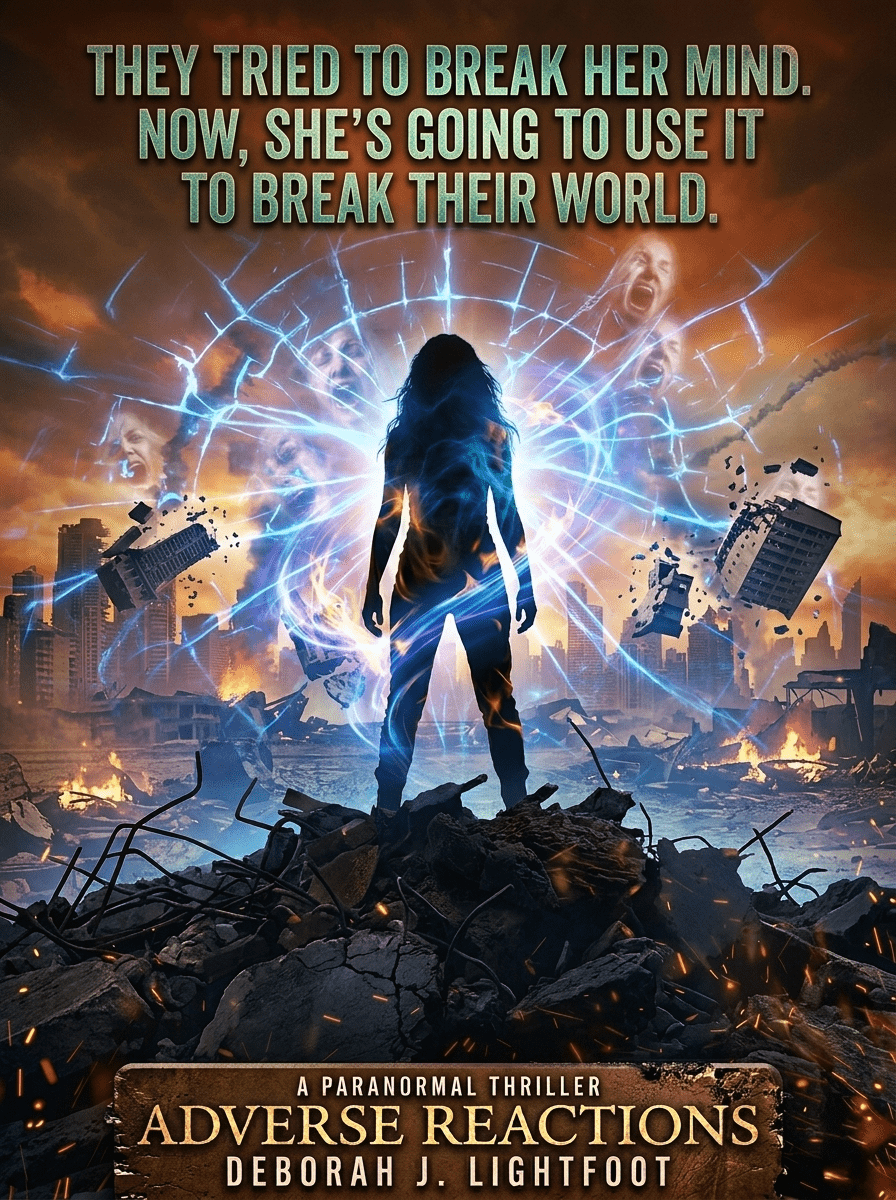
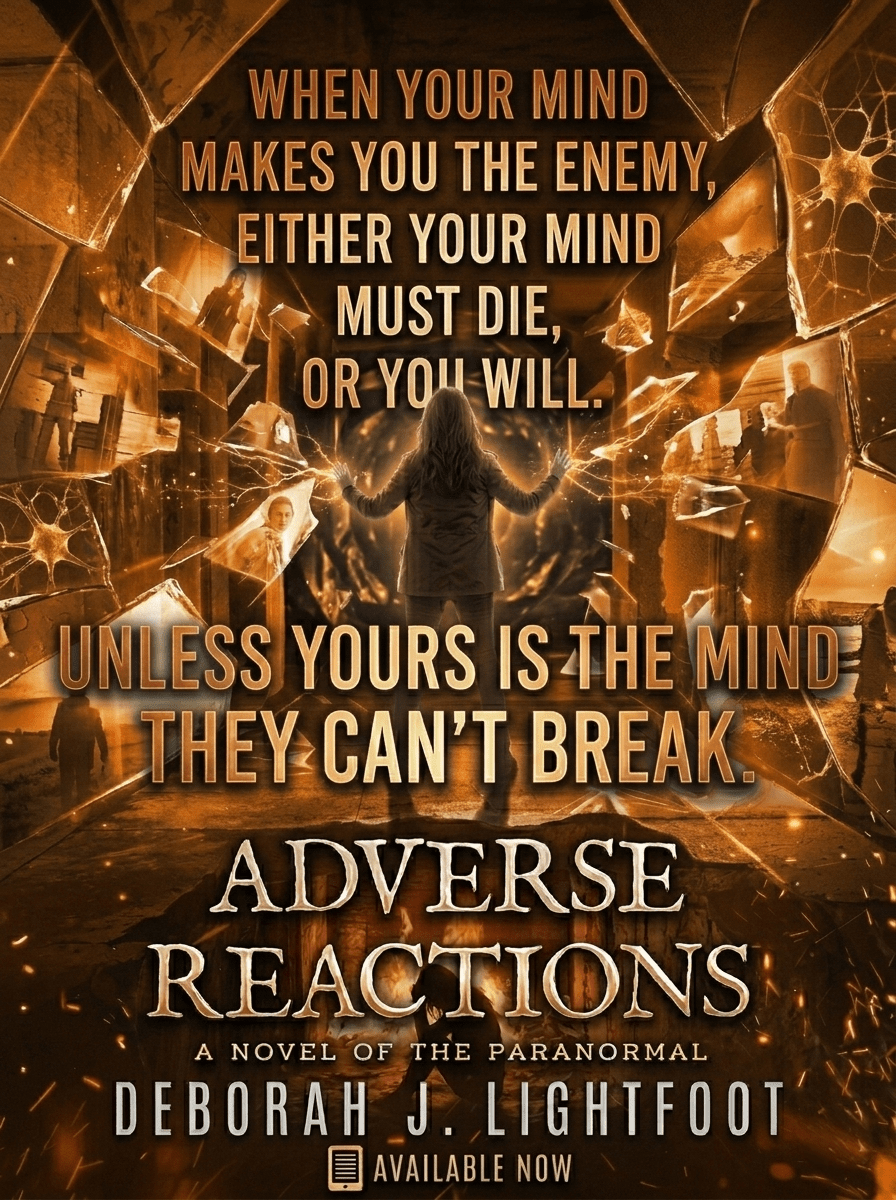
When your mind makes you the enemy, either your mind must die, or you will.
Unless yours is the mind they can’t break.
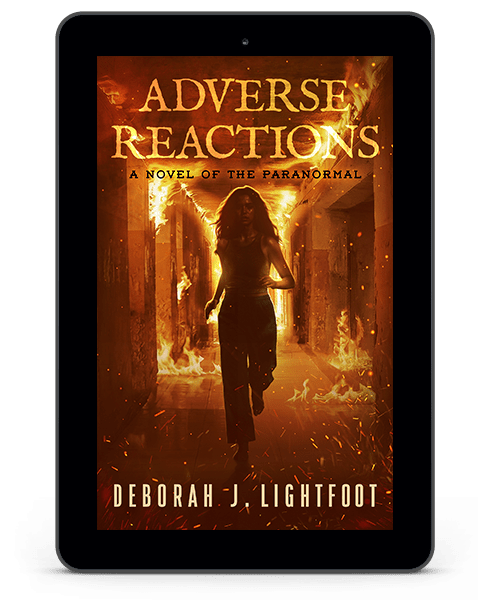
Adverse Reactions
by Deborah J. Lightfoot
Genre: Dystopian Paranormal Suspense

Purity demands a
bullet. Devin brings a reckoning.
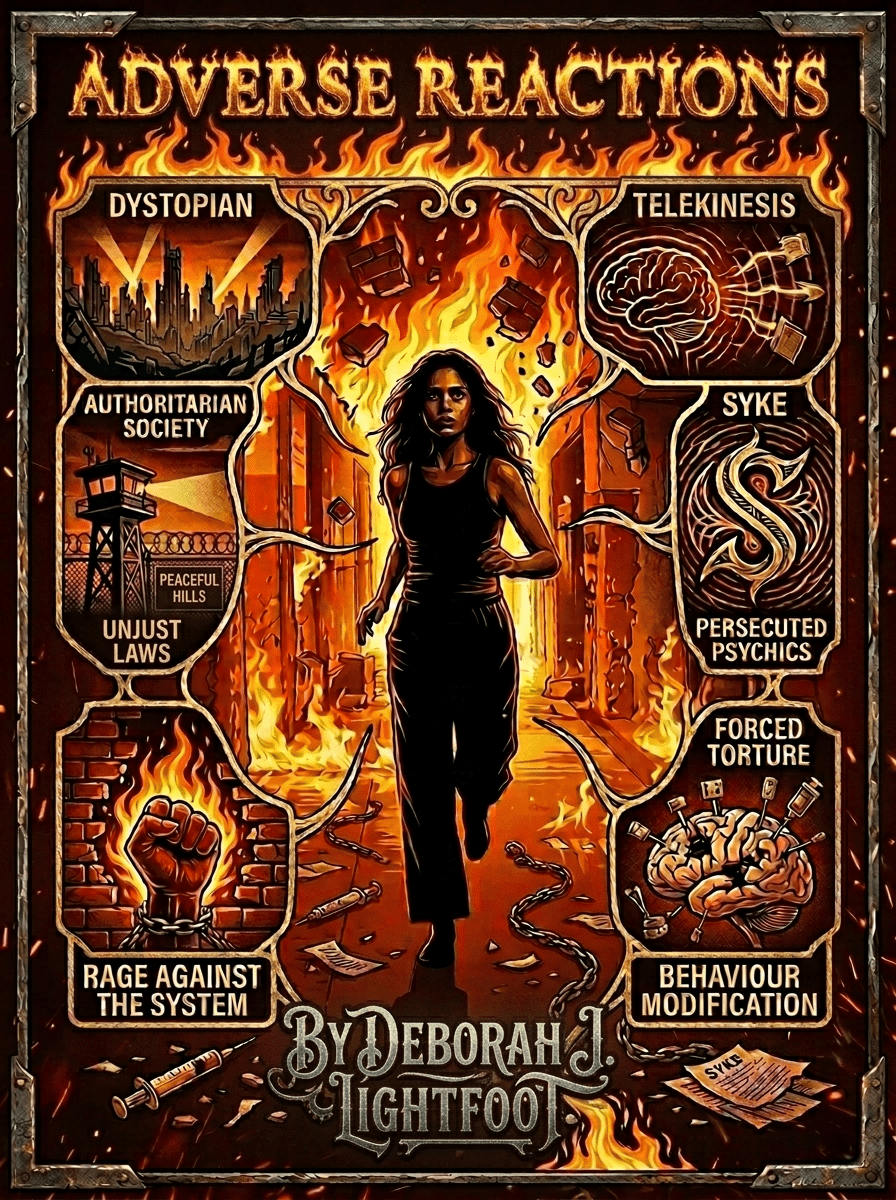
Since she was six years old, Devin Perridin has been locked behind the walls of
the family home to keep her hidden from those who would kill her. But at
sixteen, she is exposed as a "Syke," one of an outlawed minority who
possess extraordinary powers of mind over matter. Snatched from hiding, she
escapes the firing squad, but only to be imprisoned in a house of horrors: the
Peaceful Hills Sanatorium and Rehabilitation Center for the Treatment of
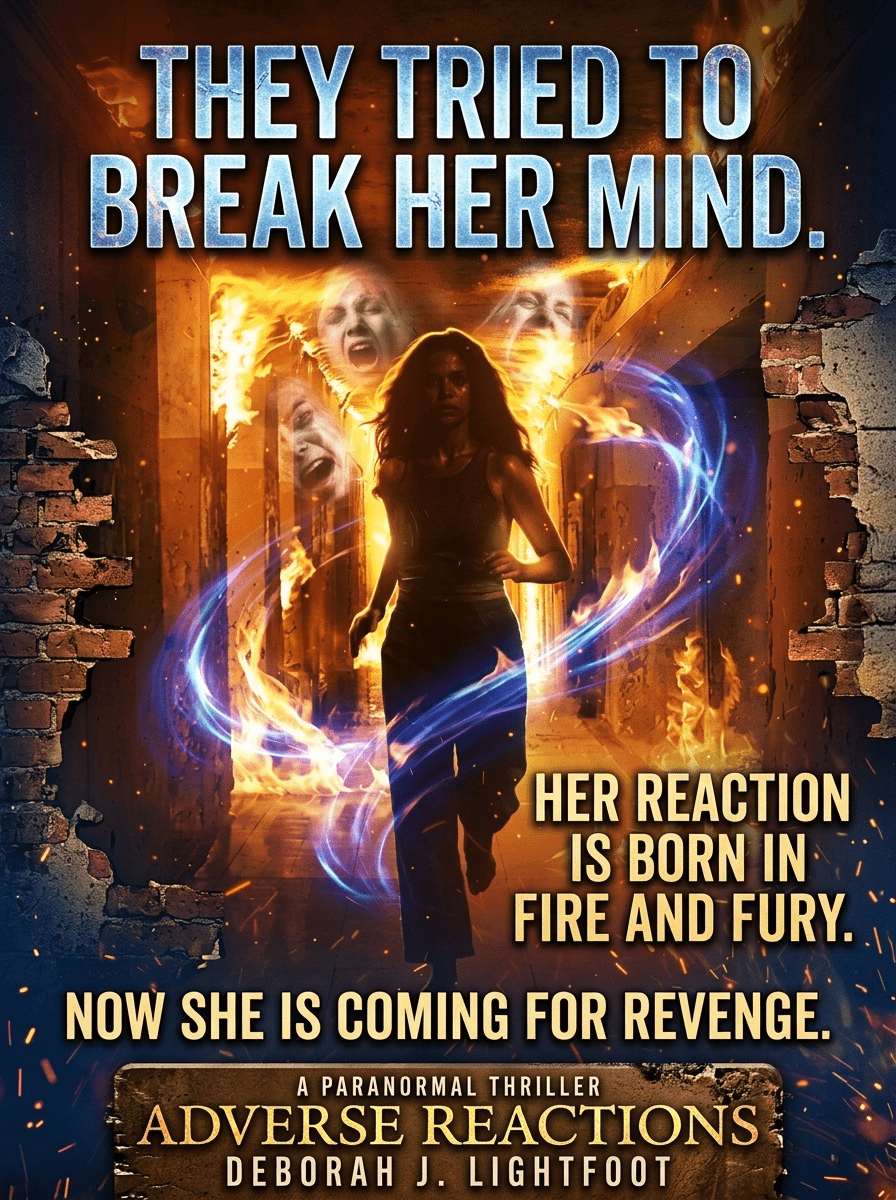
Persistent Mental Disorders. After an unknown time of torture and
"behavior modification," brutally designed to destroy her
psychokinetic reflexes, she emerges from the asylum severely damaged in mind
and spirit. Her salvation may lie in the series of crimes triggered by her
release: first kidnapping, then attempted murder, and then a mustering of
forbidden forces to assault the remote pseudo-psychiatric facility where she
had been tortured into near-mindlessness.
Drawing upon a strength she had always known was hers but had never before been
able to consciously control, Devin defies the authoritarian society with its
unjust laws that demand her death. She pushes through pain, isolation, and
moral quandaries to seek justice for not only herself, but all members of a
maligned and cruelly persecuted minority. A post-apocalyptic, paranormal
allegory for the times in which we live.
When your mind makes you the enemy,
either your mind must die, or you will. Unless yours is the mind they can't
break.
“This novel is
immediately immersive, with an opening scene that sucks readers in with vivid
sensory detail and a great sense of suspense.” —The Black List
“What a story!
I was picked up from the first page and you never let me go thereafter. The
premise is original … compelling … convincing.” —ARC Reader
“A very
enjoyable read. Excellent pacing. Immersive language. Polished, effortless
writing. I’d love to see a prequel (or three)!” —ARC Reader
“Relevant to
the current situation in the world. Ostracizing others who are different out of
fear and ignorance. Cruelty and inhumanity.” —ARC Reader
“Believable and
relatable.” —The Black List
“Thematically
rich, as Devin faces constant self-doubt but eventually comes to find
empowerment in the unique abilities that have made her an outcast.” —The
Black List
**Get it #OnSale for only $1.99 4/21 – 4/24!**
Amazon * Apple
* B&N
* Kobo
* Bookshop.org
* Smashwords * Bookbub
* Goodreads

Chapter 1
VAPORS BILLOWED INTO the chamber in thick masses of orange. Devin choked
on the sickly sweet odor.
“Don’t
fight it, child,” came the voice—equally cloying—from the darkness beyond the
floodlit, glass-walled chamber. “Give yourself up to it.”
The gas
surged into Devin’s face, blinding, gagging her. She made it go away. By force
of will, a moment’s mental reflex, she flung it back.
Fresh
air flooded her nostrils and drove out the syrupy stink. She sucked in a cool,
clean breath.
“No!”
snapped the voice, crackling with amplified static. “You must not.”
The
therapist dropped her with two thousand volts. Devin collapsed to the chamber’s
floor, her body jerking, her nerves on fire. The pain was beyond enduring. A
pain this intense must be lethal. But she did not die. As she convulsed, her
muscles knotted in spasms, she could not scream. No part of her, not even her
voice, was under her voluntary control.
“Try it
again, child.” Smooth and saccharine once more, her unseen therapist spoke from
the concealing shadows as the shock ended and Devin’s pain faded. “Stand up,”
the torturer ordered. “And this time, do not fight it. Or your
punishment will be the same: swift, sure, and severe.”
Devin
struggled upright. She had to brace against the curved glass wall of the gas
chamber to keep on her feet. Her muscles had melted from knots into jelly.
An
orange cloud flooded the chamber and filled her nose with the stink of rotting
fruit.
“Breathe
it,” her therapist instructed. “You must.”
But
again, Devin reacted by instinct alone. No conscious thought interposed between
stimulus and response. The cloud approached; she pushed it away. Pure reflex,
action of mind: act of self-preservation. The gas held back, suspended in
midair, blocked by the power of her impulse.
On the
instant, thousands of volts knocked her to the floor. Pain engulfed Devin, such
a pain as must be lethal but wouldn’t do her the service of killing her. She
writhed, silent and barely conscious.
Her
therapist withdrew the punishment. Devin remained on the floor of the isolation
chamber, curled in the fetal position, her long brown hair covering her face.
Her body was hers to command once more, but her muscles had no strength to
obey.
“You
give new meaning to the word persistent, don’t you, girl?” muttered the
disembodied voice. Then, more forcefully: “The first step toward healing is to
admit you are diseased, Miss Perridin. You have an illness. A mental disorder.
I am offering you the cure—in a pleasant aerosol spray that you need only
breathe. Once inhaled, the drug acts quickly, and its effects are lasting. But
you must take the first step and acknowledge that you want to be cured.”
The
voice grew soft, sugary. “Child, for as long as you hold to the notion—the
mistaken notion—that your disorder is in some way a strength or a benefit to
you, you will continue to fail. And you will suffer the consequences of that
failure. We can’t have that, can we?”
Devin
gathered the remnants of her strength and rolled onto her back. To stand was
impossible; she could barely shape a word.
“No,”
she whispered.
She
wasn’t speaking to her tormentor.
But:
“That’s the spirit!” the therapist responded, sounding genuinely enthused. “Now
we try again. Take your medicine like a good girl.”
The
orange stink flowed in at the top of the chamber. Devin, lying face up, watched
through the curtain of her hair as the cloud descended. She had time to ward it
off, to make it go away. But in the soul of her being, nothing sparked. Her
reflexes, her instincts, failed to respond. What had been a spontaneous force
of mind over matter could offer no resistance.
Devin’s
mouth filled with the sickening taste of defeat. The orange cloud enveloped
her, a sticky weight, and she choked down lungfuls.
“Wonderful!”
her therapist exclaimed. “My dear, I couldn’t be more pleased. This is the
tipping point. Your recovery will be much easier from now on, I promise.”
Devin
breathed the sickly sweet drug and felt the core of her mind go dead.
Then came
the retching. Her body contorted in gut-shredding paroxysms as the drug made
her vomit—or attempt to vomit. Her keepers had starved her for so long, her
stomach had nothing to bring up. The dry heaves racked her with such violence
that she could not breathe. After long moments, unconsciousness brought relief.


Castles in the cornfield provided the setting for Deborah J.
Lightfoot’s earliest flights of fancy. On her father’s farm in Texas, she grew
up reading tales of adventure and reenacting them behind ramparts of
sun-drenched grain. She left the farm to earn a degree in journalism and write
award-winning books of history and biography. High on her bucket list was the
desire to try her hand at the genre she most admired. The result is Waterspell,
a multi-layered fantasy series about a girl and the wizard who suspects her of
being so dangerous to his world, he believes he’ll have to kill her … which
troubles him, since he’s fallen in love with her.
Website * Facebook * Instagram * Bookbub * Amazon
* Goodreads
Random Thoughts on Horses, Cats, and A Room of My Own
Guest post by Deborah J. Lightfoot, author of ADVERSE REACTIONS and other books
In every novel I’ve written, horses are the main way people get around. In my latest, Adverse Reactions, there is a train, but it’s a leftover, a relic from an earlier era that had a greater degree of mechanization. The train seldom runs now, and it transports only a select few people. Most folks ride horses.
That seems natural to me. I grew up around horses. My cousins owned several and I got to go riding with them. I always wanted a horse of my own but I never had one. Even so, I felt a bond with horses. My dad grew winter wheat on our farm. Horse owners would pay to pasture their animals each winter on our lush green fields. I’d wrap up in a heavy coat and boots and brave the winter winds to go commune with the horses for hours at a time. Even animals that were half wild and hard to manage would generally let me walk right up to them. I’d curry their coats and work the knots out of their manes. I like horses and cats. Both have affectionate natures, but with an aloof, self-contained dignity that I love and respect.
Not surprisingly, given my outdoorsy, farm-girl upbringing, I still live in the country. My local area is best described as a rural-suburban neighborhood. Everyone around me owns land, ranging from a couple of acres to unfenced pastures stretching to the horizon. My place is at the small end of that scale, but still big enough that I need a monstrous, loud, riding mower to get over it all. I love the peace and quiet out here (when nobody’s mowing, that is).
I also love my private writing space, the room that is entirely my own. It’s upstairs in the quietest part of my house and gets the afternoon sun. Except in the depths of winter, and in springtime when the birds are singing outside, the window A/C runs constantly, filling the room with the same kind of white noise as in a shower. I do a lot of thinking in the shower. It’s where I solve many writing problems. Phrases come to me, new directions suggest themselves, answers arrive to questions that I might have been puzzling over for weeks. I love running water. The window air-conditioner in my upstairs office does a great job of simulating its sound.
My little office is purpose-built, it’s not a converted bedroom. In designing our house, my husband made sure to give me plenty of built-in bookshelves. Also electrical outlets! I’ve got lots of plug-ins for electronics. My space is quite cluttered because I almost never file anything away. I’m a piler, not a filer. Somewhere I read that creative people prefer piles. It’s our natural way of organizing information.
Well, I’ve rambled for long enough. 😁 Thank you for this guest post opportunity!



No comments:
Post a Comment