A sniper.
A surf contest.
A father with everything to lose.
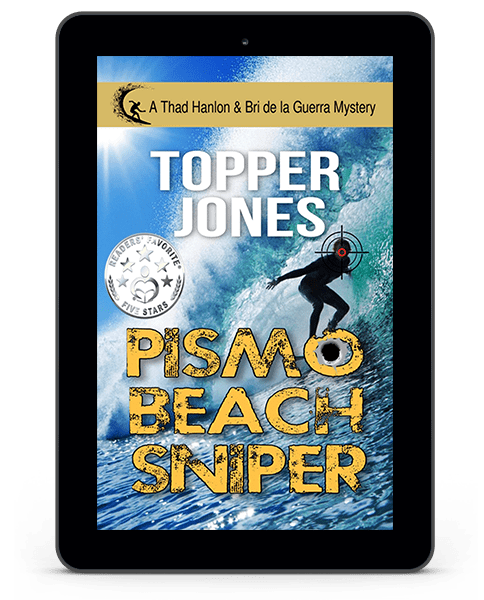
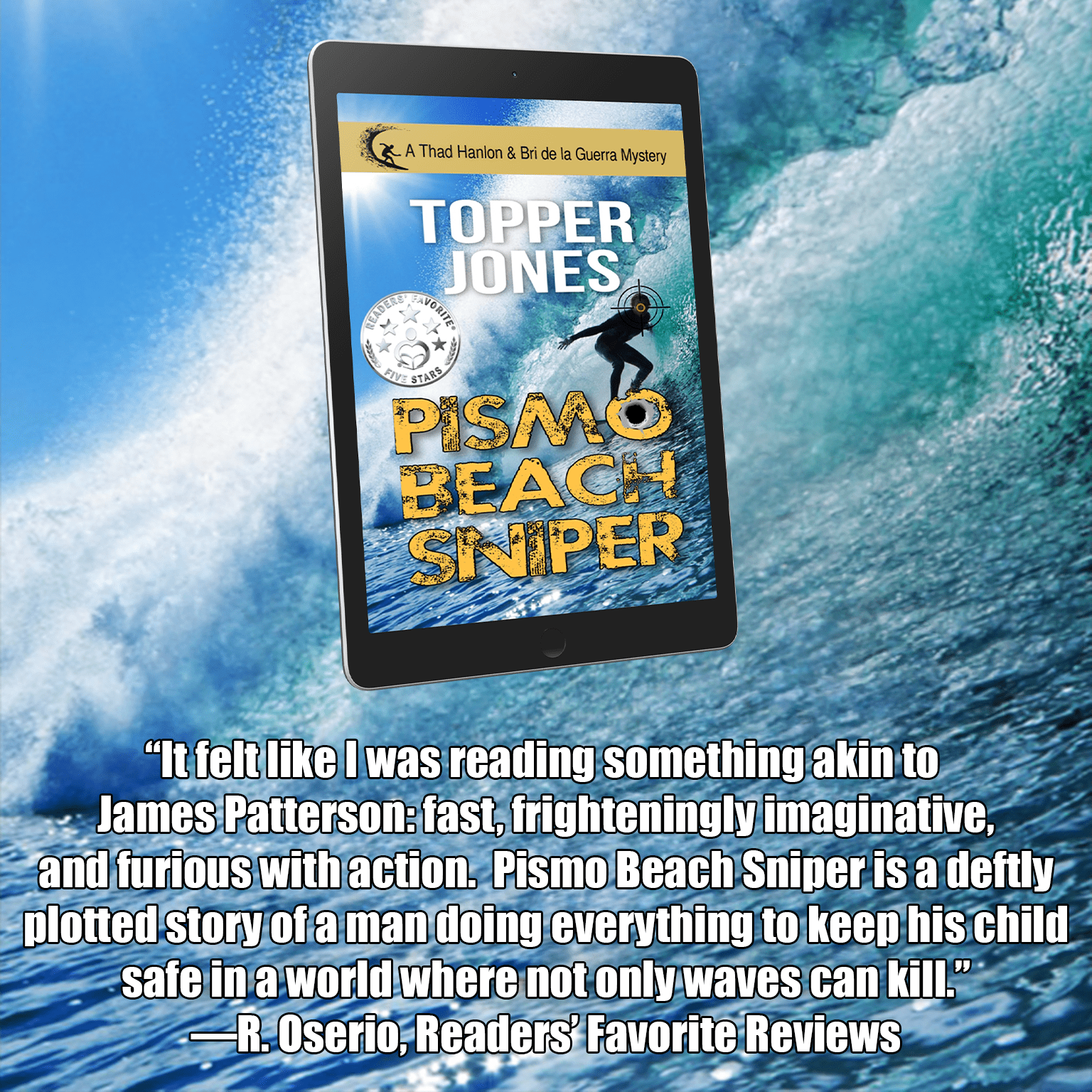
Pismo Beach Sniper
A Thad Hanlon/ Bri de la Guerra Mystery Book 3
by Topper Jones
Genre: Private Investigator Mystery

When sniper fire erupts at the Central Coast Surf Trials at
Pismo Beach, private investigator Thad Hanlon is thrust into every parent’s
worst nightmare. His eleven-year-old son and two teammates are shot while
surfing—one critically injured—plunging the contest into chaos and terrorizing
the tight-knit Five Cities beach community.
The shooter disappears, torching his hideout, leaving only questions in his
wake. Random attack—or the first move in a deadly game? Why target young
surfers? And is the marksman finished…or just getting started?
Urged by desperate parents, Hanlon and his sharp-witted partner, Bri de la
Guerra, race to protect the kids as they train for the upcoming West Coast
Championships. But as the detective duo close in on the sniper, they uncover a
chilling truth: the surf team isn’t his ultimate target—and the nightmare is
far from over.
This gripping thriller will keep you turning pages late into the night.
What Critics Are Saying
“Engaging characters, wit, and suspense elevate this rip-curling
page-turner.”
— Kirkus Reviews
“Pismo Beach Sniper is a tense and fast-moving mystery
with real emotional stakes. The target audience is readers who enjoy mystery,
private investigator fiction, crime thrillers, action suspense, coastal noir,
and family-driven detective series. Readers who like Robert Crais’s Elvis Cole
and Joe Pike novels may appreciate the same mix of banter, loyalty, and
wounded-hearted heroism, though Jones swaps Los Angeles grit for Central Coast
surf and spiritual undertow.”
— Literary Titan
“It felt like I was reading something akin to James Patterson: fast,
frighteningly imaginative, and furious with action. Pismo Beach
Sniper is a deftly plotted story of a man doing everything to keep his
child safe in a world where not only waves can kill.”
—R. Oserio, Readers’ Favorite Reviews
Amazon * Author’s Site * Bookbub * Goodreads

Chapter 1
I was sitting under a beach canopy in the spectator
section of the California Central Coast Surf Trials, watching the first heat of
the semifinals, when I heard the sonic crack of a large firearm. Something
long-range like the scoped high-precision rifle my business partner, Bri, uses
to qualify at the Five Cities Shoot’n Center.
“What was that?” my son’s surf coach asked. Gev Burian
was sitting on my left. “Sounded like it came from behind us.”
Bri de la Guerra, on my right, stood to check things
out. “Cityside, yeah. I’m thinking .30 cal. Maybe three-oh-eight.”
I swiveled to scan the low-rise buildings of downtown
Pismo—the seafood cafes, souvenir shops, and beach rentals. Clumps of tourists
meandering down narrow Pomeroy Avenue stopped. Some gazed skyward, herd-like,
examining the highest roofline—the old Hotel Pier Vista. Others rushed indoors.
When a second blast didn’t happen soon after, I saw
pedestrians raise their palms in the classic “what’s up” shrug before
continuing their weekend saunter. Some, trailing well-groomed dogs on leashes,
took refuge in their smartphones.
I turned to face the Pacific as Bri sat in her folding
chair. Coach Gev got out his binocs and we rejoined the hundreds of other
parents, friends, and supporters along the beach to watch the tournament.
Three junior surfers, ages eleven to twelve—”grommets”
in surf jargon—were perched on their boards 100 yards offshore in the chilly
morning waters north of Pismo Pier. The contestants wore different colored
jerseys over their wetsuits. Red jersey had priority takeoff; the next wave was
his. As the kids waited for the sets to roll in, they bobbed in the mushy surf
like sitting ducks.
“Yellow’s down!” Coach Gev shouted. He handed me his
binoculars. “The kid’s slumped sideways off his board.”
“Cramp, maybe?” I pressed the field glasses to the
bridge of my nose, fiddling with the adjustments. “January water temps are
cold, fifty-three, fifty-four degrees. These temps? He should have worn a 5/4/3
mm instead. Maybe even a—”
There was a second sonic crack. I watched Yellow’s board
splinter into pieces. Chunks of the foam core ringed the downed contestant as
he struggled to keep his head above water.
Red jersey, closest to Yellow, dropped prone and paddled
with fury toward him. Just as he was about to grab Yellow’s arm, I heard shot
three. There was a splash near the tail of Red’s board.
Red turned turtle, flipping his tri-fin surfboard over
so the bottom faced the sky. Only his hands, gripping the sides of the
shortboard, were exposed.
Shot four took out Red’s middle fin. Shots five and six
took out the two outer fins. Red let go of his board and sank out of view.
That left the eleven-year-old in the light blue jersey
as the only contender sitting on the water. My son, Zael, was in full
competition mode, hyper-focused on The One Thing—a wave with his name on it. A
wave built by the sea gods just for him, for his performance, his tricks, the
ones he’d stick. The 10-rating he’d be awarded by all three judges. That
perfect ten.
Zael was in the zone, tunnel vision his ally. Chaos
bending to will. He had no clue what had happened to Red and Yellow.
I popped out of my beach chair, sprinted from our shade
canopy to the shoreline, and screamed as I waded in. “Duck and cover, Zael! Get
down! Now!” I waved my arms, zigzagging through the shallows.
My son wasn’t hearing me, wasn’t seeing me, wasn’t even
attuned to my panic despite his gift for sensing things unspoken. Zael paddled
hard for takeoff, slid into the three-foot wave breaking off the pier, and
dropped into the curl. He drove down the line, pumping his board to build
speed, then bottom turned, and angled toward the lip to launch into his
signature 360-degree air rotation and—
Blam.
Shot seven.
Zael’s right leg buckled. He lost balance and angled into a dive as far away from his board as his leash would let him. When he didn’t come up for air...
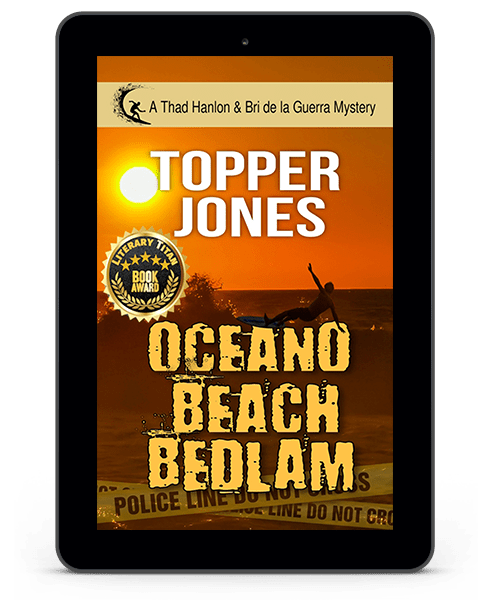
Oceano Beach Bedlam
A Thad Hanlon/ Bri de la Guerra Mystery Book 2
Hanlon & de la Guerra have gone full service. In this
second book in the surfing crime-fighter mystery series, Thad Hanlon and his
martial-arts-obsessed partner, Bri de la Guerra, hang out their shingle as
newly licensed private investigators. Now in addition to fraud-busting, the two
detectives do it all. Background checks. Surveillance. Even finding lost souls.
Just about anything that requires sleuthing or going undercover.
All they need is a client.
That’s when a former exotic dancer from Bakersfield CA shows up looking for her
surf prodigy son who’s gone missing in the wake of cult violence terrorizing
the California Central Coast.
What Critics
Are Saying
“A crunchy detective novel set in the world of California surfers.
Jones delivers a proper beach read, both in form and content.”
-Kirkus Reviews
“Honestly, I had a blast with this one. Oceano Beach
Bedlam is a smart and entertaining read. If you like your mysteries with
surfboards, sass, and just enough heart to keep you caring, this one’s for you.
It’s a great pick for fans of offbeat detectives, fast dialogue, and
sun-drenched noir with a brain and a soul. I’d recommend it to readers who
enjoy Janet Evanovich, Robert Crais, or the beachier edges of Elmore Leonard.”
— Literary Titan
Amazon * Author’s Site * Bookbub * Goodreads

All That Glisters
A Thad Hanlon/ Bri de la Guerra Mystery Book 1
When the facts don’t add up in his surf buddy’s bizarre
death, forensic consultant (and daddy-to-be) Thaddeus Hanlon investigates,
volunteering to go undercover to pick up where best friend Rafi Silva left off
in a secret probe of the U.S. gold stockpile—every last bullion bar.
Rafi’s spunky fiancée, Bri de la Guerra, has suspicions of her own and soon
joins Thad on the hunt for answers. Together, the two amateur sleuths delve
deep, stumbling onto a financial a-stock-alypse in the making, triggering a
brutal manhunt along the Eastern seaboard meant to silence anyone looking to
set the ledger straight.
What Critics
Are Saying
“Jones’ action-packed murder mystery...is
tension-fueled with plenty of twists and two appealing sleuths. In this
detective series opener, Thad Hanlon, a 27-year-old forensic accountant,
becomes the target of a murderous cadre when he accepts a new assignment that
takes him from Los Angeles to the East Coast center of power. Woven into the
gripping plot are sensual, detailed descriptions of Thad’s adventures riding
the waves, which should please the surfer crowd and afford others a visceral
sense of the experience.”
—Kirkus Reviews
“All That Glisters by Topper Jones is well-written with not a
single dull moment. I liked the way the author included elements of action,
mystery, and even some cyber investigating. Overall, I found this book to be an
amazing read.”
—Sefina Hawke, Readers’ Favorite Reviews
Amazon * Author’s Site * Bookbub * Goodreads



Writing
as Topper Jones, award-winning author Christopher G. Jones, Ph.D., delivers
detective fiction with a dash of romance, plenty of action, and memorable
characters. His Thad Hanlon & Bri de la Guerra Mystery Series has earned
Readers’ Favorite Five Stars and the Literary Titan Gold Book Awards.
Website * Facebook
* X
* Instagram
* TikTok
* Bookbub
* Amazon
* Goodreads
GUEST POST
What kind of research do you do before you begin writing a book?
I research initial details for my character sketches, scene locations, and police procedure during the outline phase of a project. This usually takes me a month. But most of my research takes place as I write. While I’m penning the draft on my first computer monitor, I use a second monitor to research. ChatGPT and Google Gemini are now my new best friends. Google Maps my next best friend. And Wikipedia and Perplexity, my go-to for an overview and footnote references to definitive research sources on a subject.
My favorite part of research is scouting locations. Especially if it involves being on the coast. That just means I have another opportunity to catch a few waves.
Advice you would give new authors?
Workshop your work! Whatever it takes, get feedback from people who are interested in your success. And be open to what fellow writers have to say. They can tell when something isn’t working, when characters behave out of character, and when your language isn’t capturing your intention. Listen and revise accordingly.
You can often find writing critique groups at your local library or through state and local writing organizations. I found my “writing safe space” through Write On – St. George, a local chapter of the League of Utah Writers. Each week, the “Writers Improvement Group” (WIG for short) meets to review what we wrote since the last session. Knowing I need to have “something for WIG” motivates me to get words on the page. The weekly goal: five pages double-spaced. For me, my critique group functions as both a sounding board and an accountability group. Everyone needs a little encouragement. Especially writers!
What makes a good story?
Anything that keeps me turning the page, usually involving a story-worthy protagonist pursuing a goal that makes a difference while facing overwhelming obstacles.
What are you currently reading?
In fiction, I’ve just finished Death by Coconut: A Holly Swimsuit Mystery (Book 7) by Susie Black and am now reading Voodoo River by Robert Crais—an Elvis Cole and Jim Pike novel (Book 5).
When it comes to audiobooks—my wife and I are on the road a lot to visit family—we’re currently listening to Michael Connelly’s Ironwood: A Catalina Novel, book two in the series.
In nonfiction, I’m reading Page One to Done: Finish Your Novel in 30 Days with the Fast Drafting Method by Jessica Brody.
What is your writing process? For instance do you do an outline first?
I’m neither a pure Planner nor a pure Pantser—I’m a Plantser!
As a big fan of the late Blake Snyder’s Save the Cat!® approach to story structure, I tend to “beat out” the major plot points in my novels, complete with scene cards. Each card has a short scene description identifying the Hero/Heroine, Goal, Obstacles, and Stakes along with notes on the emotional change from scene opening to scene close.
As I write the scene, sometimes magic happens and the “players” don’t behave as I expect. So, I end up channeling the characters, leading to surprises I never would have imagined during the outline phase of the project.
Listening to the Muse means trusting the “pantsing” side of my brain. When that happens, I’m more than happy to rewire the plot. For my writing process, it’s both plotting and pantsing. But always plotting first.
How long on average does it take you to write a book?
Now that I have three novels under my belt, my average time to draft, workshop, and revise a book is about one year. My writing group members keep telling me I need to write faster, but with 20 grandkids and 5 great-grandkids between my wife and me, we’re on the road a lot for sports events, choir and orchestra concerts, play performances, and birthdays. I love to write, but first priorities, first.
Still, my writing group is correct. I really do need to find a way to write faster. Lately, I’ve been experimenting with what Jessica Brody calls Fast Drafting in her recently released book on writing craft—Page One to Done. In this how-to book, she provides a structured approach to helping writers complete a first draft of a novel in as little as 30 days. Recently, I watched Jessica demonstrate her technique in a webinar. I was impressed and vowed to try fast drafting for myself. So...ask me again in three hundred sixty-five days how long it takes to pen a novel, and I might be able to truthfully say “considerably less than a year.” It’s worth a try.
Have you ever had writer’s block?
Once.
After completing what I thought would be a bestseller, I sent off my manuscript to a major New York literary agency for review and evaluation for possible representation. I soon learned my book was “Dead on Arrival!” The feedback was scathing. This was in the early 1980s. I put the stillborn novel in a drawer.
I was besieged by crippling writer’s block, fearing I was wasting my time trying to write, dismayed I wasn’t a natural, and terrified that storytelling was beyond me. I told myself sad jokes: Why did the budding author buy a caseload of cornstarch? He thought if he could find a way to add it to his novel, the plot would thicken.
Truth was, for me, the plot never thickened because I had no clue how to plot. That first draft gathered dust in the drawer for the next 30 years.
To find a way forward, I devoured everything on the language of storytelling. That’s when I came across Blake Snyder’s trilogy on screenwriting—Save the Cat!®, Save the Cat!® Goes to the Movies, and Save the Cat!® Strikes Back. I couldn’t put these books down. I just loved Blake’s first-person account of adventures in the screen trade and his fusion approach to writerly advice—part craft, part self-help book. And I was encouraged by his unquenchable optimism: “Given enough patience to find it, every story problem has an answer,” he wrote.
My reality: I had a STORY PROBLEM.
Cut to August 27, 2016, when I took a two-day Save the Cat!® Beat Sheet Workshop. It was in that workshop that I learned my problem was (1) a matter of the right story pattern (my original draft was a mashup of two different kinds of stories) and (2) the need to structure the story with key plot points. Over the next two days, I zeroed in on the best story type (mystery) for my novel and nailed down what Blake Snyder calls the essential 15 beats. From there, it was only a matter of time before I was able to knock out the second draft, scene by scene. Writer’s Block removed!
What would you say is your interesting writing quirk?
My workspace, which includes—
A relatively clear desk except for the most recent draft of my work in progress;
A high-speed computer with two high-resolution monitors;
An ergonomic keyboard and chair;
A desktop fountain burbling;
Soft instrumental music playing in the background (usually Classical Baroque);
A storyboard on the wall plastered with scene cards from all three acts of the novel I’m working on;
And finally, a window with a view.
What is your work schedule like when you’re writing?
The calendar on my iPhone has a daily entry “Write Now” set for a three-hour block from 9 a.m.-12 noon.
Oh, oh, oh...if only I were that disciplined.
The calendar event acts more as an inspiration to remember to get words on the page each day. That’s my goal. And I do keep track using the Active Daily Word Count Calculator spreadsheet from author Jessica Brody’s course “Writing Mastery: Productivity Hacks for Writers.”
How do books get published?
There’s a little magic to it and a healthy dose of hope. You write, and write, and revise, and query until you find just the right agent or publisher. Then you hand off your manuscript and hope the magic happens one more time.

Follow the tour HERE
for special content and a giveaway!
Enter the Pismo Beach Sniper Giveaway Here

I want to thank INSIDE THE INSANITY for their blog post spotlighting my Thad Hanlon & Bri de la Guerra Mystery Series and the release of PISMO BEACH SNIPER. Loved the Guest Post about my writing process—the quirks, the schedule, and the magic of getting published.
ReplyDelete