

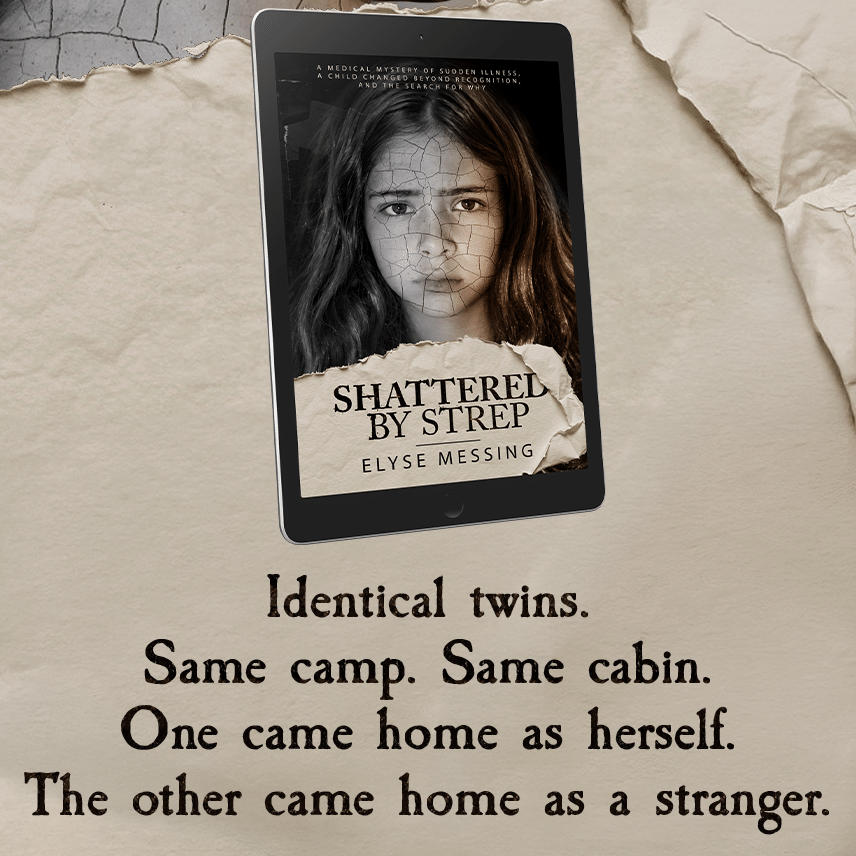
Identical twins.
Same camp. Same cabin.
One came home as herself.
The other came home as a
stranger.

Shattered by Strep:
A Medical Mystery of
Sudden Illness, a Child Changed Beyond Recognition, and the Search for Why
by Elyse Manning
Genre: Medical Mystery, Memoir

Identical twins. Same
camp. Same cabin. One came home as herself. The other came home as a stranger.
"Get it out
of my head!"Twelve-year-old Liv screamed it in the car after
summer camp, striking her own temple with her fist.
Four weeks earlier, she had been "the Mayor," the
funny, bossy twin who ran every party. Now she wouldn't eat, couldn't stop
blinking, and exploded in rages that seemed to come from nowhere. Within weeks,
she had lost almost a fifth of her body weight.
Everyone saw an eating disorder. Her mother saw a child who
had changed almost overnight, and she kept asking why. The search for answers
eventually led to PANDAS/PANS, a little-known condition associated with immune
responses to infections, including something as common as strep.
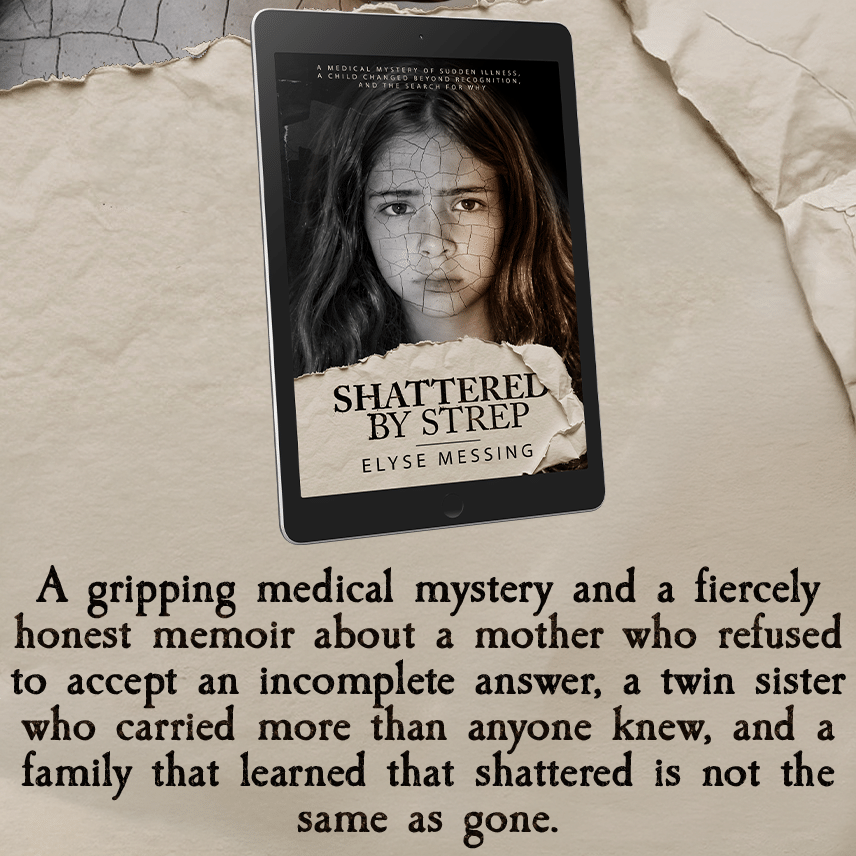
Shattered by Strep
is a gripping medical mystery and a fiercely honest memoir about a mother who
refused to accept an incomplete answer, a twin sister who carried more than
anyone knew, and a family that learned that shattered is not the same as gone.
Every parent should
read it before they need it.
Amazon * * Bookbub
* Goodreads

Three Club crackers sat on the counter between us.
“Please eat these,” I said.
Liv looked at them but did not reach. I tried again, softer
this time. “Just three.”
A few weeks earlier, I would never have noticed whether my
twelve-year-old daughter ate three crackers. I would have left a sleeve on the
counter, walked away, and assumed hunger would take care of the rest. By then I
noticed everything. I watched what she touched, what she broke into smaller
pieces, what she moved around without eating, and how long food stayed on a
plate before she found some way not to finish it. Meals had stopped being
background noise in our house. They had become events the entire family could
feel approaching.
That afternoon, Liv sat at the bar across from the kitchen
island, with the rest of the family nearby. I opened the snack drawer, trying
to find something small enough not to turn into another fight. Club crackers
were familiar and plain, the kind of thing I had packed into lunch boxes or
handed to the girls in the car without a second thought. They didn’t look like
a meal, and three of them seemed so insignificant that I convinced myself she
could manage them.
I had already tried softer voices and firmer ones. I had
bargained, reduced portions, offered different foods, then offered them again.
I was still approaching the problem as though the right combination of patience
and authority could solve it. Liv had always been able to tell me what she
wanted. She argued, negotiated, complained, and usually had several reasons
ready when she disagreed with me. Now I could ask why she wouldn’t eat and get
no answer that made what I was seeing easier to understand.
“Please,” I said again.
Finally, she picked up one cracker. Relief moved through me
so quickly that I almost felt foolish for being relieved. For a second, I
thought I had found a request small enough to get around whatever was happening
to her. Then she reached for more.
Liv grabbed the crackers by the fistful and began smashing
them against her face. Crumbs broke across her cheeks and lips as she pushed
crackers into her mouth, then spat them back out. Pieces scattered across the
counter and fell to the floor. She kept grabbing more, using the food and her
hands against her own face while I stood there trying to understand how a
simple snack had turned into something so violent.
“Will this make you happy?” she screamed.
The whole family saw it. I wish I could say that fear made
me gentler or that I immediately recognized a child in distress and responded
as she needed. I did not. I screamed back. The exact words have blurred, but I
remember the force of my own voice and the awful belief beneath it that if I
became firm enough, I could force the situation back into something I
understood. I wanted her to eat the crackers, stop screaming, stop doing
whatever this was, and somehow become herself again.
None of that happened. Liv kept raging while cracker pieces
clung to her face and clothing, and the rest of the family watched the two of
us come apart over something that should have been simple. I was horrified by
what she was doing, terrified by what it might mean, and angry because I had no
idea how to stop it. For days, I had tried to reason with her, feed her,
comfort her, and understand why the daughter who had returned from camp seemed
so different from the one I had sent away. Every effort brought the same
answer: I could not reach her.
Then I began to cry. The anger left almost as quickly as it
had arrived, and I moved toward her, wanting to console her, only to realize
that I no longer knew what consolation required. Should I hold her or give her
space? Take the food away or keep insisting because I could see her becoming
thinner? Apologize for pushing or keep pushing because I was frightened of what
would happen if I stopped? Every response seemed capable of being wrong.
What alarmed me most was not simply that Liv refused the
crackers. If she had told me she hated them, I could have offered something
else. If she had been angry with me, I could have waited for the anger to pass.
If she had told me she was afraid, I could at least have tried to understand
the fear. Instead, my daughter had turned three crackers into something violent
and screamed at me as though they represented something far larger than either
of us could name.
I kept looking at food because food was the part of the
crisis I knew how to measure. I could count bites, sips, crackers, and pounds.
I could see what remained on a plate and watch the number on a scale move in
the wrong direction. What I could not measure was the distance that had opened
between Liv and the rest of us. I couldn’t explain how a girl who left for camp
full of opinions, plans, friends, sports, and certainty came home looking at me
with the same face, yet seeming unable to find her way back into her own life.
By then, I had already seen enough to know that something
was wrong, but I was still trying to solve the most visible part. If I could
get food into her, I thought, perhaps the rest of her would follow. Perhaps
hunger, exhaustion, or whatever had happened at camp had scrambled something
temporarily, and nourishment would put it back. The idea gave me a task, and
tasks were easier to tolerate than questions.
The crackers were all over the counter and floor. Liv was
crying. I was crying. The rest of the family stood inside the aftermath of a
moment none of us knew how to explain. I looked at my daughter and understood,
with a fear I could not yet organize into words, that this was no longer about
three crackers. It would be months before anyone said the word that finally
fit.
The question that stayed with me was much larger.
What happened to you?


Elyse Messing is a mother of four, an Ivy League graduate,
and an entrepreneur who co-founded a successful business more than two decades
ago. But nothing in her education or professional life could have prepared her
for the day her daughter's world began to unravel.
When her once-vibrant daughter suddenly developed
frightening behavioral and physical symptoms, Elyse found herself searching for
answers that the medical system seemed unable to provide.
What followed was a journey that challenged everything she
thought she knew about medicine, motherhood, and trusting her own instincts.
Shattered by Strep is her deeply personal account of that
journey. Through her writing, Elyse hopes to raise awareness of PANDAS/PANS,
help other families recognize the warning signs, and encourage parents to keep
asking questions when something doesn't feel right.
Website * Facebook * Instagram * Bookbub * Amazon
* Goodreads



No comments:
Post a Comment